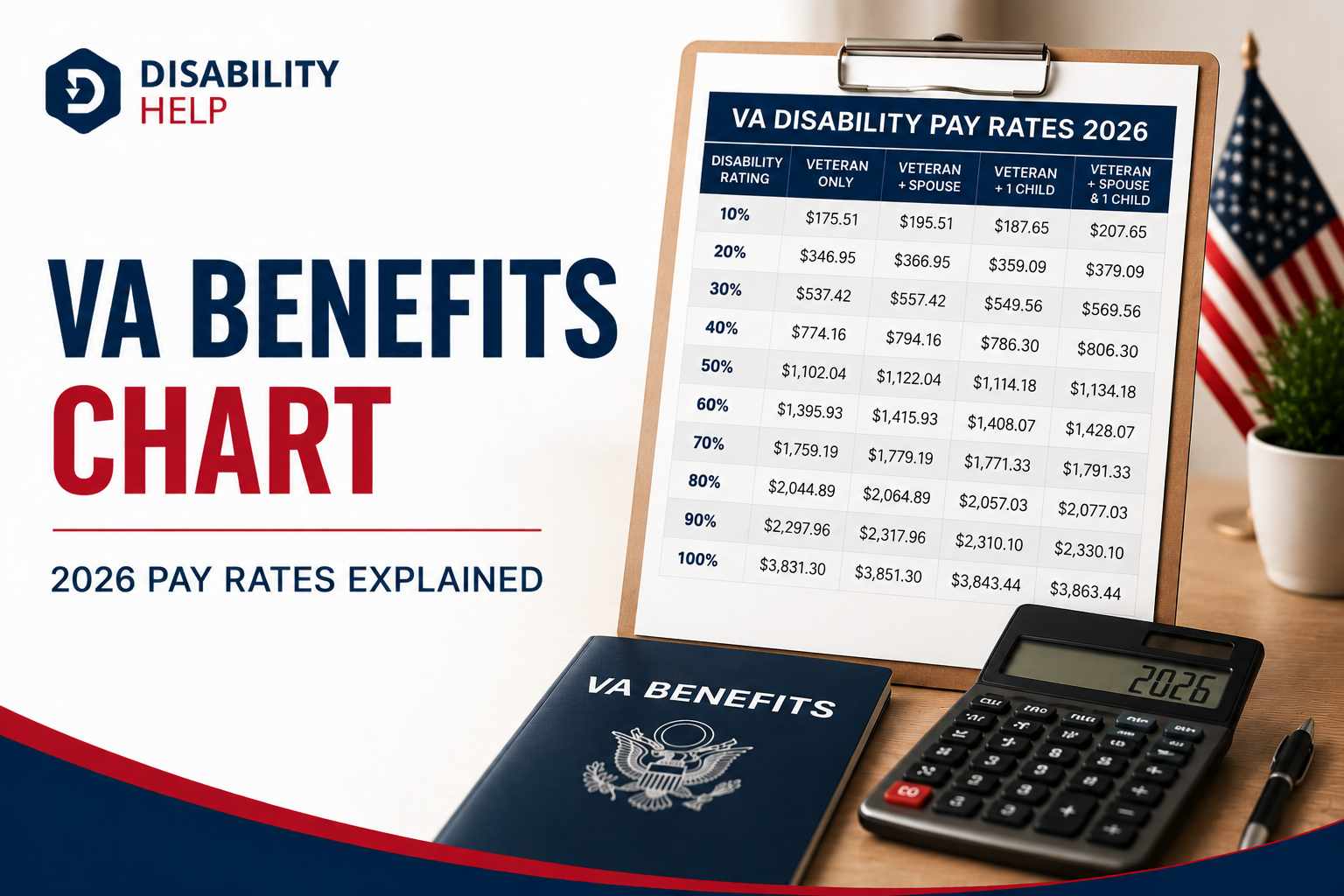
The 2026 VA disability pay chart shows tax-free monthly compensation ranging from $180.42 at a 10% rating to $4,510.65 at a 100% rating with a spouse and two dependent parents, reflecting a 2.8% cost-of-living adjustment effective December 1, 2025. The Social Security Administration announced the 2.8% COLA on October 24, 2025, and federal law requires VA disability rates to match it. According to the VA's FY 2024 Annual Benefits Report, nearly 6 million veterans receive VA disability compensation, and 1,547,842 of them are rated at 100%.
This guide breaks down the 2026 pay amounts by rating, explains how dependent additions work at 30% and higher, covers Special Monthly Compensation and Dependency and IndemnityA legal principle requiring one party to compensate another for harm or loss, relevant in disability... Compensation, and shows you how to verify the exact amount you should receive.
Key Takeaways
- 2.8% COLA increase: VA disability rates rose 2.8% effective December 1, 2025, matching the Social Security Administration's annual cost-of-living adjustment for inflation.
- Tax-free at all levels: VA disability compensation is not taxed federally or by any state and is not reported as income on your annual tax return.
- Dependent pay starts at 30%: Veterans rated at 10% or 20% receive a flat monthly amount; additional compensation for spouses, children, and dependent parents begins at the 30% rating.
- 2026 base rate range: Monthly pay runs from $180.42 at 10% to $3,938.58 at 100% for a veteran alone, with higher amounts when dependents are claimed.
- Maximum standard rate: A 100% rated veteran with a spouse and two dependent parents receives $4,510.65 per month in 2026, the top of the standard pay chart.
- Special Monthly Compensation: Veterans with severe injuries such as loss of limb, blindnessThe condition of having no vision or very limited visual perception., or housebound status receive additional payments ranging from $139.87 to over $6,000 per month.
- Survivor benefits: Surviving spouses of veterans who died from service-connected causes receive a base DIC payment of $1,699.36 per month in 2026.
How the 2026 VA Disability Pay Chart Changed from 2025
The 2026 VA disability pay chart reflects a 2.8% cost-of-living adjustment that took effect December 1, 2025, with the first increased deposit landing on December 31, 2025. The Social Security Administration announced the 2.8% COLA on October 24, 2025, and federal law (38 U.S.C. § 5312) requires VA compensation to match the SSA adjustment.
The COLA is calculated from the Consumer Price Index for Urban Wage Earners and Clerical Workers (CPI-W), comparing the third quarter of 2024 to the third quarter of 2025. The purpose is straightforward: protect the purchasing power of your benefits so a flat dollar amount does not lose ground to inflation each year. If the CPI-W does not show an increase in a given year, no COLA is applied, which has only happened three times in the last 50 years (2010, 2011, and 2016).
The 2.8% increase is smaller than the 3.2% adjustment in 2025 and far below the 8.7% spike in 2023, but it is in line with the long-run average. For a veteran rated 100% with no dependents, the monthly payment rose from $3,831.30 in 2025 to $3,938.58 in 2026, an increase of $107.28 per month, or about $1,287 over the year.
2025 vs 2026 Monthly Payment Comparison (Veteran Alone, No Dependents)
| Disability Rating | 2025 Monthly Rate | 2026 Monthly Rate | Monthly Increase |
|---|---|---|---|
| 10% | $175.51 | $180.42 | $4.91 |
| 30% | $537.42 | $552.47 | $15.05 |
| 50% | $1,102.04 | $1,132.90 | $30.86 |
| 70% | $1,759.19 | $1,808.45 | $49.26 |
| 100% | $3,831.30 | $3,938.58 | $107.28 |
Note: rates are sourced from the VA's official Veterans disability compensation rates page. Use the VA tables as the source of truth, because third-party charts can copy older figures or round incorrectly.
2026 VA Disability Pay Chart for 10% and 20% Ratings
Veterans with a 10% or 20% disability rating receive a flat monthly payment in 2026, and dependent status does not change the amount. The VA only adds compensation for a spouse, children, or dependent parents starting at the 30% rating level.
| Disability Rating | Monthly Payment (Veteran Only) |
|---|---|
| 10% | $180.42 |
| 20% | $356.66 |
Even at these lower ratings, the compensation comes with collateral benefits worth tracking: VA health care eligibility, the VA home loan funding fee waiverA legal provision that allows states to forego certain requirements of federal law, often used in th..., and access to vocational rehabilitationServices that help individuals with disabilities prepare for, obtain, and maintain employment. and employment services. If your condition has worsened, you may also be eligible to file for an increased rating, which is reviewed using your most recent medical evidence.
2026 VA Disability Pay Chart for 30% to 60% Ratings
Starting at the 30% rating, the VA pay chart adds compensation for dependents. The table below shows the basic monthly rates for the 30%, 40%, 50%, and 60% levels based on dependent status.
| Dependent Status | 30% | 40% | 50% | 60% |
|---|---|---|---|---|
| Veteran alone | $552.47 | $795.84 | $1,132.90 | $1,435.02 |
| With spouse | $617.47 | $882.84 | $1,241.90 | $1,566.02 |
| With spouse and 1 parent | $669.47 | $952.84 | $1,329.90 | $1,671.02 |
| With spouse and 2 parents | $721.47 | $1,022.84 | $1,417.90 | $1,776.02 |
| With 1 parent | $604.47 | $865.84 | $1,220.90 | $1,540.02 |
| With 2 parents | $656.47 | $935.84 | $1,308.90 | $1,645.02 |
| With spouse and 1 child | $666.47 | $947.84 | $1,322.90 | $1,663.02 |
| With 1 child (no spouse) | $595.47 | $853.84 | $1,205.90 | $1,523.02 |
The dependent amounts above already include one spouse or one child. If you have additional children, a schoolchild over 18, or a spouse who receives Aid and Attendance benefits, you add the supplemental amounts shown in the Additional Compensation table later in this guide.
2026 VA Disability Pay Chart for 70% to 100% Ratings
Compensation rises sharply at the 70%, 80%, 90%, and 100% rating levels. The 100% rate is also the baseline used to calculate Total Disability based on Individual Unemployability (TDIU), which pays at the 100% rate even if a veteran's combined rating is lower, but service-connected conditions prevent substantially gainful employmentWork that provides a living wage and is within the capacity of an individual, including those with d....
| Dependent Status | 70% | 80% | 90% | 100% |
|---|---|---|---|---|
| Veteran alone | $1,808.45 | $2,102.15 | $2,362.30 | $3,938.58 |
| With spouse | $1,961.45 | $2,277.15 | $2,559.30 | $4,158.17 |
| With spouse and 1 parent | $2,084.45 | $2,417.15 | $2,717.30 | $4,334.41 |
| With spouse and 2 parents | $2,207.45 | $2,557.15 | $2,875.30 | $4,510.65 |
| With 1 parent | $1,931.45 | $2,242.15 | $2,520.30 | $4,114.82 |
| With 2 parents | $2,054.45 | $2,382.15 | $2,678.30 | $4,291.06 |
| With spouse and 1 child | $2,074.45 | $2,406.15 | $2,704.30 | $4,318.99 |
| With 1 child (no spouse) | $1,910.45 | $2,219.15 | $2,494.30 | $4,085.43 |
The jump from the 90% rate to the 100% rate is the largest single increase on the chart, more than $1,500 per month for a veteran alone. That is why the difference between a 90% combined rating and a 100% rating is worth careful review, particularly if you have unrated conditions, a worsening service-connected condition, or grounds for TDIU.
How to Read Your VA Disability Pay Chart in 5 Steps
Reading the chart correctly is the difference between confirming you are paid accurately and quietly losing hundreds of dollars per month. Follow these five steps to verify your 2026 monthly amount.
- Find your combined disability rating. This is the percentage on your most recent VA decision letter or available through your VA.gov account. If you have multiple service-connected conditions, it is the combined rating after VA math, not the sum of the individual percentages.
- Identify your dependent status. Match yourself to one of the eight standard rows: veteran alone, with spouse, with spouse and parents, with parents only, with spouse and one child, or with one child only. Dependent additions only count at a 30% rating or higher.
- Match your rating column with your dependent row. The value where the two intersect is your basic monthly rate. Veterans rated at 10% or 20% receive a flat amount regardless of household.
- Add any applicable supplemental amounts. Each additional child under 18, each schoolchild over 18, and a spouse who receives Aid and Attendance each adds their own line item to your monthly total.
- Verify your actual deposit matches the chart. Compare your December 31, 2025, deposit and every subsequent monthly deposit against the chart amount. If the number is lower than it should be, contact VA at 1-800-827-1000 to open an inquiry.
Additional Compensation Beyond the Base Pay Chart
The base pay chart is not the only source of monthly compensation. Three categories of additional pay sit on top of the standard rates and frequently go uncollected because veterans do not know they qualify.
Added amounts for additional dependents (2026)
| Additional Allowance | 30% | 50% | 70% | 100% |
|---|---|---|---|---|
| Each additional child under 18 | $32.00 | $54.00 | $76.00 | $109.11 |
| Each schoolchild over 18 (in school) | $105.00 | $176.00 | $246.00 | $352.45 |
| Spouse receiving Aid and Attendance | $61.00 | $101.00 | $141.00 | $201.41 |
Special Monthly Compensation (SMC)
Special Monthly Compensation is paid in addition to, or in place of, the standard rates when a veteran has a severe disability or combination of disabilities. SMC levels are designated by letter (K, L, M, N, O, R, S, and others). The most common are:
- SMC-K: $139.87 per month, added on top of basic compensation for the loss or loss of use of a creative organ, a hand, a foot, or for blindness in one eye with light perception only.
- SMC-L through SMC-O: $4,900.83 to roughly $6,000 per month for a veteran alone, covering specific severe disabilities such as the loss of both hands or feet, blindness, or being permanently bedridden.
- SMC-R: paid to veterans who need daily personal care help from another person for basic self-care needs.
- SMC-S: paid to veterans who are housebound, meaning service-connected disabilities permanently confine them to their immediate premises.
Full SMC amounts and eligibility rules are listed on the VA's official Special Monthly Compensation rates page, and SMC has its own COLA-adjusted schedule that updates alongside the basic pay chart each year.
Dependency and Indemnity Compensation (DIC)
DIC is a tax-free monthly benefit paid to eligible survivors of service members who died in the line of duty, or of veterans whose deaths resulted from a service-connected condition. For surviving spouses of veterans who died on or after January 1, 1993, the 2026 base DIC rate is $1,699.36 per month. The amount is higher when:
- The veteran had a totally disabling VA rating for at least the 8 full years before death, and the spouse was married to the veteran during that same 8-year period: add $360.85 per month.
- The surviving spouse has a dependent child under 18, needs Aid and Attendance, or is housebound: additional allowances apply.
Full DIC rate tables, including survivor parent rates, are published on the VA's DIC rates page.
How Combined Disability Ratings Affect Your Monthly Payment
The VA does not simply add individual disability ratings together. It uses a formula often called 'VA math' that applies each rating to your remaining percentage of health, not to the full 100%. The order matters, and the result is then rounded to the nearest 10% to set your combined rating, which is what the pay chart uses.
Here is the practical effect. A veteran with a 50% rating for PTSD, 50% for sleep apneaA sleep disorder characterized by repeated interruptions in breathing during sleep, often treated wi..., 20% for diabetesA chronic condition where the body cannot produce or properly use insulin, leading to high blood sug..., and 20% for a back condition has individual ratings adding up to 140 in regular arithmetic. Under VA math, the combined rating is 80%. Per the 2026 pay chart, a veteran alone at 80% receives $2,102.15 per month, while the same veteran at 100% would receive $3,938.58, a difference of $1,836.43 every month, or more than $22,000 per year.
Because the combined ratings table compresses values near 100%, each additional rating past 70% buys less than the one before it. That makes accurate documentation of every service-connected condition, plus an honest look at TDIU eligibility, financially significant. The VA's official disability ratings explanation walks through the formula step by step. If you are unsure how your combined rating was calculated, you can request a copy of your rating decision and verify each component yourself.
Key Terms in the 2026 VA Disability Pay Chart
The VA pay chart uses several terms that have specific legal and administrative meanings. Understanding them helps you read your decision letter and your monthly deposit correctly.
- Combined disability rating: Your final percentage after the VA applies its ratings formula across all service-connected conditions and rounds to the nearest 10%. This is the column you use on the pay chart.
- Cost-of-living adjustment (COLA): The annual percentage increase applied to VA disability compensation, legally required to match the Social Security Administration's COLA. The 2026 COLA is 2.8%.
- Dependent: A spouse, an unmarried child under 18 (or under 23 if attending school), a child who became disabled before age 18, or a parent for whom the veteran provides more than half of the support.
- Aid and Attendance (A&A): An added monthly allowance for a spouse who needs regular help with daily activities. The 2026 A&A amount for a 100% rated veteran's spouse is $201.41.
- Special Monthly Compensation (SMC): A higher payment tier for veterans with severe disabilities, paid in addition to or instead of the base pay chart amount.
- Total Disability based on Individual Unemployability (TDIU): A pathway that pays at the 100% rate when service-connected conditions prevent substantially gainful employment, even if the combined rating is below 100%.
- Effective date: The date your benefits begin to accrue, which determines retroactive (back) pay. For most direct service connection claims, it is the date the VA receives your claim or the date the condition first occurred, whichever is later.
- Retroactive pay: A lump-sum payment for the months between your effective date and the month VA approves your claim, calculated at the rate in effect for each historical period.
What Veterans Should Know About the 2026 Pay Schedule
In our editorial work covering VA disability, the question that comes up most often is not what the chart says, but whether a veteran's deposit actually reflects what the chart says. The VA processed an all-time record 3,001,734 disability compensation and pension claims in fiscal year 2025 and distributed $195 billion in compensation and pension payments, according to the VA's November 2025 announcement. VA Secretary Doug Collins said veterans "deserve fast and accurate claims decisions," and the data support the volume.
But high volume creates room for individual errors: a dependent who was added but not entered into the system, a rating increase that was approved but not paid out from the correct effective date, or a missing SMC line item.
Three things to check this year, especially in the first three months after a COLA adjustment:
- Confirm that the December 31, 2025, deposit reflected the COLA. If your monthly amount did not change between November and December 2025, the new rate may not have been applied to your account.
- Verify your dependent record is current. Newly married spouses, new children, schoolchildren turning 18, or a spouse newly approved for Aid and Attendance all change your monthly amount. Update them through VA Form 21-686c or directly in your VA.gov account.
- Cross-check your SMC eligibility. SMC is frequently underclaimed because it requires the veteran to know it exists. If you have a service-connected loss of use, blindness, or housebound status, your monthly compensation should include an SMC line in addition to the base pay chart amount.
If something looks wrong, the VA's individual case line is 1-800-827-1000. You can also designate an accredited representative to act on your behalf at no cost: accredited Veterans Service Organizations (VSOs) such as the DAV, the American Legion, and VFW handle this for free. VA-accredited claims agents and attorneys can also represent you and, by federal regulation, cannot charge fees for initial claims.
Fees on initial claims, fast-track services, or 'guaranteed approval' promises are signs of a scam. As the brand we are part of consistently warns: legitimate disability benefits programs do not charge upfront for help with free government processes.
Putting the 2026 Pay Chart to Work
As of May 2026, the updated VA disability pay chart is in full effect, and the next COLA adjustment will not arrive until December 2026. That gives you a full year to confirm your record is accurate, your dependents are properly listed, and any condition that has worsened is documented. If your rating, dependent record, or SMC eligibility has changed since your last decision letter, the gap between what you should be receiving and what is actually being deposited each month compounds quickly. The VA's effective date rules mean that filing earlier protects more back pay, even if the underlying claim takes time to develop.
If you’re still navigating the broader system, from filing claims to understanding effective dates and back pay, we encourage you to dive deeper into our resources. Start with our comprehensive guide on VA 100% permanent and total disability benefits to fully map out your benefits and next steps.
Frequently Asked Questions
When does the 2026 VA disability pay chart take effect?
The 2026 VA disability pay chart took effect on December 1, 2025. The first deposit reflecting the 2.8% COLA increase was issued on December 31, 2025, because VA disability is paid on the first business day of the month following the month it covers. Rates remain in effect through November 2026, when the 2027 COLA will be applied.
Is VA disability compensation taxable in 2026?
No. VA disability compensation is tax-free at both the federal and state levels and is not reported as income on your tax return. This applies to base compensation, Special Monthly Compensation, Dependency and Indemnity Compensation, and Combat-Related Special Compensation. If you also receive military retirement pay, only the retirement portion is taxable, as shown on your DFAS Form 1099-R.
What is the maximum VA disability pay rate in 2026?
The maximum standard pay rate in 2026 is $4,510.65 per month, paid to a veteran rated 100% with a spouse and two dependent parents. Veterans who qualify for Special Monthly Compensation at levels L through R can receive higher amounts, in some cases over $9,000 per month for the most severe disabilities. SMC is paid in addition to the chart rate.
Do dependents increase my VA pay at every rating?
No. Dependents only increase your VA disability pay at the 30% rating and higher. At 10% and 20%, the monthly amount is flat regardless of whether you have a spouse, children, or dependent parents. This is why some veterans pursue a rating increase past 20%, the financial impact of dependent additions becomes available only above that threshold.
What if my VA disability deposit is lower than the 2026 chart shows?
Compare your most recent deposit against the rate that matches your combined rating and dependent status. If the amounts differ, the most common causes are an outdated dependent record, a withhold for military retirement pay (CRDP/CRSC), an offset for disability severance pay, or a calculation error. Call the VA at 1-800-827-1000 to open an inquiry, and request a written explanation of any deduction.
How are retroactive (back) payments calculated under the 2026 rates?
Retroactive payments are calculated using the rate that was in effect for each month of the back-pay period, not the current 2026 rate. If your effective date is in 2023, those months are paid at the 2023 rates, 2024 months at the 2024 rates, and so on. The 2026 rates apply only to monthly payments from December 1, 2025 forward.
- “Veterans Benefits Administration Reports,” U.S. Department of Veterans Affairs, 2023, https://www.benefits.va.gov/REPORTS/detailed_claims_data.asp
- “The Most Common VA Disability Ratings,” VA Claims Insider, 2023, https://vaclaimsinsider.com/most-common-va-disability-ratings/