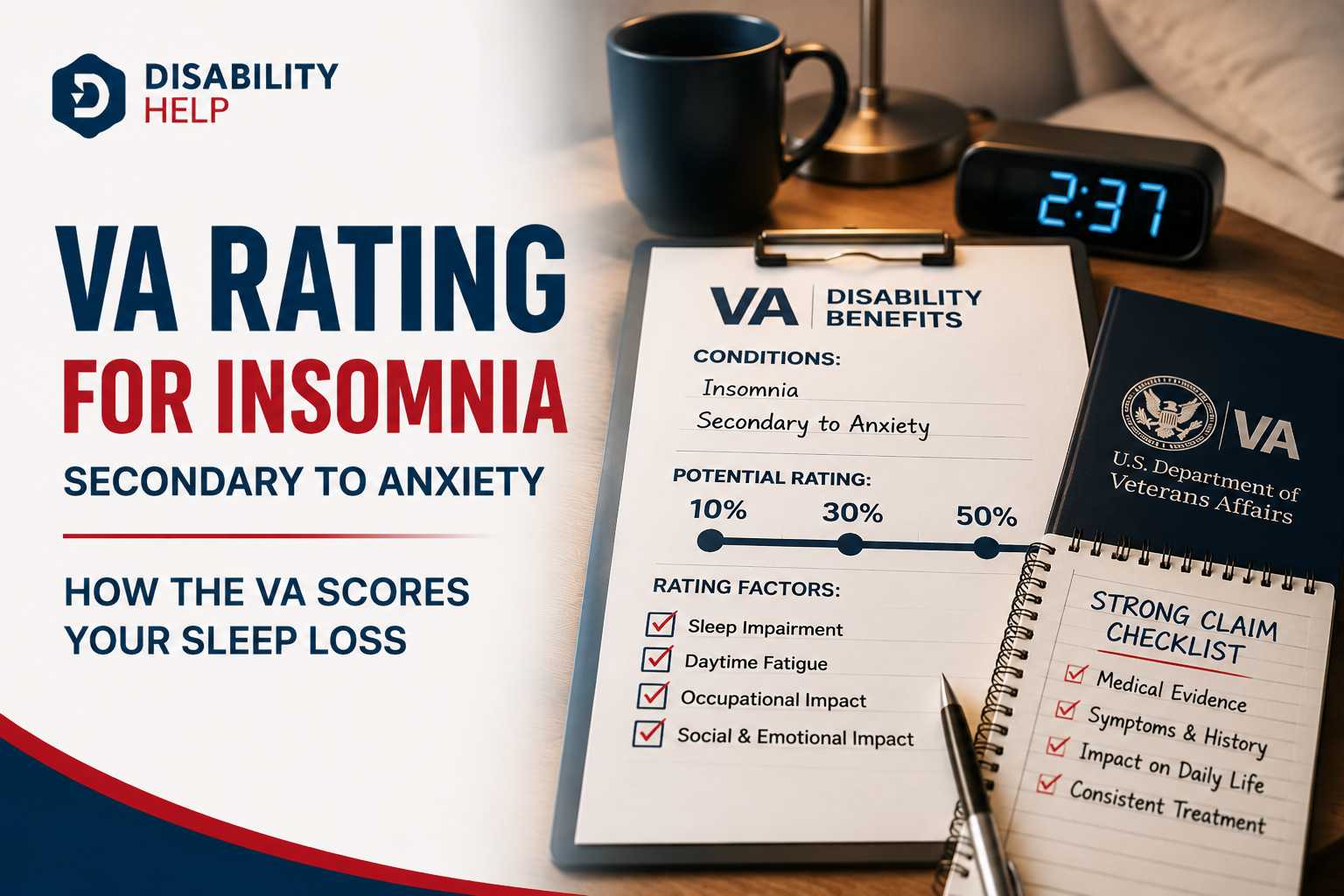
The VA rating for insomnia secondary to anxiety is not a separate number. The VA folds your sleep loss into the single rating it assigns your service-connected anxiety disorderA mental health condition involving excessive, persistent worry or fear., scored from 0% to 100% under the General Rating Formula for Mental Disorders. That one rating sets your monthly payment.
Insomnia is one of the most common problems veterans carry home. A VA study of more than 5,500 post-9/11 veterans found that 57% had insomnia disorder, far above the roughly 30% rate in the general adult population (VA Office of Research and Development). When that sleep loss is driven by anxiety, the way the VA scores it changes how your whole claim plays out.
This guide explains how the rating works in 2026, why you cannot stack a second rating on top, the medical proof you need, and what to do if the VA gets it wrong.
Key Takeaways
- One rating, not two: The VA rating for insomnia secondary to anxiety is included in your anxiety rating, never paid as a separate disability award.
- The pyramiding rule: Federal regulation 38 CFR 4.14 bars two ratings for the same symptoms, so sleep loss and anxiety share one evaluation.
- Chronic sleep impairmentA loss or abnormality of a body structure or function, whether physical, mental, or sensory, often a... counts: The mental health rating formula names chronic sleep impairment as a symptom supporting a 30% rating, and more with greater impairment.
- A nexus letter is the key: A medical opinion that your insomnia is at least as likely as not caused by anxiety links the two conditions for the VA.
- 2026 payments scale fast: A 30% mental health rating pays $552.47 a month in 2026, while a 70% rating pays $1,808.45 for a veteran with no dependents.
- TDIU is a path to 100% pay: If anxiety and insomnia keep you from steady work, Total Disability based on Individual Unemployability can pay at the 100% rate.
How Does the VA Rate Insomnia Secondary to Anxiety?
The VA rates insomnia secondary to anxiety under the General Rating Formula for Mental Disorders in 38 CFR 4.130. Your insomnia does not earn its own percentage. The examiner counts your sleep symptoms toward the single rating assigned to your anxiety disorder, which runs from 0% to 100%.
The VA stopped treating insomnia as a standalone ratable condition. Its adjudicationThe legal process of resolving a dispute or deciding a case, including those involving disability ri... manual instructs raters that when insomnia shows up as a symptom of an underlying disability, service connection attaches to the primary diagnosis, and the sleep symptoms get included in the evaluation of that condition. For a veteran whose poor sleep stems from anxiety, the anxiety disorder is the rated condition and the insomnia rides inside that score.
The VA uses specific diagnostic codes to name the anxiety disorder, including 9400 for generalized anxiety disorder, 9411 for post-traumatic stress disorder, 9412 for panic disorder or agoraphobia, 9403 for social anxiety disorder, and 9413 for unspecified anxiety disorder. The code identifies the condition, but every one of these disorders is scored with the same rating formula. A related example is the adjustment disorder with anxiety VA rating, which the VA also measures by how much the condition limits work and daily life rather than by the label alone.
Why You Cannot Get a Separate Rating for Insomnia: The Pyramiding Rule
The VA will not assign a second rating for insomnia because of a rule called pyramiding. Under 38 CFR 4.14, the VA cannot pay you twice for the same symptom or the same loss of function. Anxiety and insomnia overlap heavily, so they share one rating.
The overlap is easy to see. Chronic sleep impairment, daytime fatigue, and trouble concentrating appear in both the anxiety symptom list and the effects of insomnia. If the VA paid one rating for the anxiety and a second for the insomnia, it would count the same lost function twice. The rule against pyramiding closes that door.
This is not the VA shortchanging you on purpose. The upside is real: documenting severe, well-recorded insomnia can push your single anxiety rating higher, because chronic sleep impairment is one of the symptoms the formula rewards with more points. Note that some sleep conditions are scored on their own. Sleep apneaA sleep disorder characterized by repeated interruptions in breathing during sleep, often treated wi..., for instance, is a physical breathing disorder with its own rating criteria, which is why a claim like sleep apnea secondary to tinnitus can carry a separate evaluation. Insomnia tied to anxiety does not.
What the Evidence Says About Anxiety and Insomnia
Anxiety and insomnia feed each other. Clinical research shows that 60% to 70% of people with generalized anxiety disorder report significant sleep problems, and disturbed sleep is one of the core diagnostic criteria for the disorder under the DSM-5 (Dialogues in Clinical Neuroscience).
The biology behind the link is well studied. Researchers point to overactivity in the corticotropin-releasing hormone system and the locus ceruleus arousal response. Prolonged stress can lock the body into a high-arousal state, which makes it hard to fall asleep and hard to stay asleep. For a veteran with anxiety, that arousal does not switch off at bedtime.
Veteran-specific data shows how widespread the problem is. The VA study of post-9/11 veterans found insomnia disorder in 57% of participants, and the rate climbed past 93% among veterans who also had PTSD. A 2025 analysis summarized by Chisholm Chisholm and Kilpatrick found that between 11.2% and 19.9% of active-duty service members may experience moderate-to-severe insomnia. Dr. Peter Colvonen of the VA San Diego Healthcare System and the University of California San Diego, who led the post-9/11 study, noted that earlier medical-record reviews logged insomnia in only about 3% of veterans, a gap that shows how often the condition goes undiagnosed. That bidirectional connection is exactly why a well-documented secondary claim succeeds.
VA Mental Health Rating Levels and 2026 Monthly Payments
Each rating level reflects how much your combined anxiety and insomnia limit your work and social life. The table below pairs each rating with its impairment standard, the sleep-related symptoms tied to it, and the 2026 monthly payment for a veteran with no dependents.
| Rating | Occupational and Social Impairment | Sleep-Related Symptoms | 2026 Pay (Veteran Alone) |
|---|---|---|---|
| 0% | Diagnosed condition with no symptoms severe enough to affect work or require ongoing medication. | Sleep complaints noted but minimal functional effect. | $0.00 |
| 10% | Mild or transient symptoms that lower work efficiency only under significant stress, or symptoms controlled by medication. | Occasional sleeplessness managed with treatment. | $180.42 |
| 30% | Occasional decrease in work efficiency with intermittent inability to perform tasks. | Chronic sleep impairment, anxiety, panic attacks weekly or less, mild memory loss. | $552.47 |
| 50% | Reduced reliability and productivity at work and home. | Frequent disrupted sleep with flattened affect, panic attacks more than weekly, impaired memory and judgment. | $1,132.90 |
| 70% | Deficiencies in most areas, including work, family relations, judgment, thinking, and mood. | Near-continuous anxiety and exhaustion, impaired impulse control, neglect of personal care. | $1,808.45 |
| 100% | Total occupational and social impairment. | Severe sleep loss alongside gross impairment in thought, communication, or behavior. | $3,938.58 |
The 2026 figures reflect the 2.8% cost-of-living adjustment that took effect on December 1, 2025, with the first higher payment landing at the end of December. Veterans rated 30% or higher who have a dependent spouse, child, or parent receive more than the amounts above. Confirm your exact figure on the official VA compensation rate tables, which third-party charts often copy with errors.
How to Prove Insomnia Is Secondary to Your Anxiety
To win a secondary claim, you must connect three dots: a service-connected anxiety disorder, a current insomnia diagnosis, and medical evidence linking the two. A nexus letter ties them together. Follow these steps to build a claim the VA can approve.
- Confirm your anxiety is service-connected. The primary condition has to already be granted, or claimed at the same time, before insomnia can attach to it.
- Get a current insomnia diagnosis. A qualified provider should document the diagnosis in your records, separate from the anxiety entry.
- Obtain a nexus letter. Ask a psychiatrist or psychologist to state that your insomnia is at least as likely as not caused or aggravated by your anxiety.
- Gather supporting records. Pull VA and private treatment records, any sleep study results, and a daily sleep journal that logs waking times and fatigue.
- Collect lay statements. Buddy letters from a spouse, family member, or coworker can describe how lost sleep and anxiety affect your mood and work.
- Prepare for your C&P exam. Be specific about hours slept, how often sleep breaks are taken, and the daytime effects on focus, irritability, and job performance.
- File the claim. Submit VA Form 21-526EZ online, by mail, or with a Veterans Service Organization, which provides accredited help at no cost.
The nexus letter does the heaviest lifting. A strong one confirms the provider reviewed your full medical history and service treatment records, states a clear diagnosis of both conditions, explains the medical reasoning that ties the anxiety to the insomnia with reference to peer-reviewed literature, and uses the at-least-as-likely-as-not standard the VA requires. A letter that simply asserts a link without reasoning carries little weight.
Key Terms Every Veteran Should Know
Secondary service connection: A benefit granted when a service-connected condition (here, anxiety) causes or worsens a second condition (here, insomnia).
Nexus letter: An independent medical opinion that links your secondary condition to your service-connected condition using the VA standard of proof.
Pyramiding: The prohibition on rating the same symptoms twice, which is why insomnia and anxiety share one mental health rating.
General Rating Formula for Mental Disorders: The 0% to 100% scale in 38 CFR 4.130 that scores every anxiety disorder by its effect on work and social life.
Compensation and Pension (C&P) exam: A VA-arranged evaluation that measures the severity of your symptoms and their impact on daily functioning.
TDIU: Total Disability based on Individual Unemployability, which pays at the 100% rate for veterans who cannot work because of service-connected conditions.
What If the VA Denies or Underrates Your Claim?
A denial or a low rating is not the end of the road. Under the Appeals Modernization Act, you have three review options, and you can move from one to another if the first does not work.
- Higher-Level Review: A more senior adjudicator re-examines the same evidence. This fits when you believe the VA misapplied the law or misread what you already submitted.
- Supplemental Claim: You add new and relevant evidence, such as a stronger nexus letter or updated records, for the VA to weigh.
- Board of Veterans' Appeals: A Veterans Law Judge reviews the case, with the option of a hearing. This route often suits complex secondary-connection claims.
If your combined symptoms keep you from holding steady work, ask about TDIU. A veteran generally qualifies with one service-connected disability rated at 60% or higher, or a combined rating of 70% with at least one condition rated at 40% or higher. Severe anxiety paired with disabling insomnia often meets that bar.
A Real Board Decision: How One Veteran Won Secondary Service Connection
Board decisions show that a secondary service connection for insomnia can be granted when the evidence is laid out clearly. In a 2021 ruling (Citation Nr 21004230), the Board of Veterans' Appeals granted service connection for insomnia secondary to an unspecified anxiety disorder.
The record worked in the veteran's favor for concrete reasons. VA treatment notes documented two separate DSM-5 diagnoses, generalized anxiety disorder and insomnia. VA examiners tied the insomnia to the service-connected anxiety and described the sleep symptoms as part of the overall psychiatric picture. The Board resolved a reasonable doubt in the veteran's favor and granted the claim. The lesson for your own file: distinct diagnoses, plus an examiner who connects them, is a combination the VA can act on.
Putting Your Claim on Solid Ground
The VA rating for insomnia secondary to anxiety comes down to one idea: your sleep loss strengthens a single mental health rating rather than earning its own. The pyramiding rule keeps the two conditions on one score, the General Rating Formula sets the percentage, and a clear nexus letter is what links them in the VA's eyes. Documenting how badly your sleep is affecting your work and daily life is the most direct way to support a higher rating.
As of 2026, with rates set by the 2.8% cost-of-living adjustment, a higher rating carries real financial weight, and a free accredited representative can help you assemble the evidence without charging upfront fees.
If your symptoms reach beyond anxiety into depressionA mental health condition marked by persistent feelings of sadness and loss of interest., the same documentation discipline applies, and you can see how veterans build toward the top tier in our guide on reaching a 100% VA disability rating for depression. Build the record, prove the link, and pursue the rating your service earned.
Frequently Asked Questions
Can you get a separate VA rating for insomnia?
Generally, no. When insomnia is a symptom of a service-connected condition, such as anxiety, the VA folds it into that condition's single rating rather than paying a second award. The rule against pyramiding blocks two ratings for the same overlapping symptoms.
What rating does insomnia secondary to anxiety usually get?
There is no fixed number, because the rating measures total impairment. Chronic sleep impairment supports a 30% rating, but severe sleep loss combined with reduced productivity or deficiencies in most areas of life can support a 50% or 70% rating.
Do you need a nexus letter for a secondary insomnia claim?
A nexus letter is strongly recommended and often decisive. It is the medical opinion that connects your insomnia to your service-connected anxiety using the at-least-as-likely-as-not standard. Without that link, the VA has little basis to grant secondary service connection.
How much does a 70% anxiety rating pay in 2026?
A 70% mental health rating pays $1,808.45 per month in 2026 for a veteran with no dependents, after the 2.8% cost-of-living adjustment. Veterans with a spouse, children, or dependent parents receive more on top of that base amount.
Can insomnia from anxiety qualify for TDIU?
Yes. If anxiety and insomnia together stop you from holding substantially gainful employmentWork that provides a living wage and is within the capacity of an individual, including those with d..., you may qualify for TDIU, which pays at the 100% rate. You generally need one disability at 60% or higher, or a combined 70% with one condition at 40% or higher.
- “General Rating Formula for Mental Disorders.” 38 CFR § 4.130 - Schedule of ratings - mental disorders, Legal Information Institute, Cornell Law School. https://www.law.cornell.edu/cfr/text/38/4.130.
- “Compensation and Pension (C&P) Examinations.” U.S. Department of Veterans Affairs, https://www.va.gov/disability/va-claim-exam/.
- “Understanding the Impact of Insomnia in Veterans.” National Center for PTSD - U.S. Department of Veterans Affairs, https://www.ptsd.va.gov/understand/related/insomnia.asp.